Summary: Problem-framing is the holy grail of good UX and Service Design. The problem is scope and problem-solving mindsets lock out good problem-framing. Nonsense, research shows, provides a frame-breaking catalyst. Productive nonsense gives us a tool to flip assumptions and find opportunity beneath.
Nonsense by Design: How Absurdity Can Break Problem Frames
Product Managers and Business teams often dictate scope. Instead of defining business problem scope, it often sets the agenda or frame for design problem-solving. As a result designers get asked to use design ‘magic’ to transform the wrong problem. You’ll hear UX veterans like Larry Marine (author of Disruptive Research) talk about this constantly. In my UX trainings, I like to say right problem framing is the most important aspect of UX and Service Design. Now with AI, wrong problem framing tends to automate existing policies and workflows– the very things that need to be ripped apart and rebuild with AI.
Problem-solving nudges teams into solutioning when we should be doing problem-finding, falling in love with the problem and using that to frame the problem we are solving.
A project may begin with a confident statement: customers need more reminders, employees resist change, users require additional training, or a new system needs a better interface. These statements sound like problems. In practice, they are interpretations (frames) containing assumptions about causes, responsibilities, boundaries, and acceptable solutions.
Once that interpretation becomes the official brief (frame), the design team works inside it. Research often gets used to reinforce it, while workshops organize outcomes around it. A provisional frame gradually becomes an unquestioned solution.
Nonsense offers designers a way to interrupt this process.
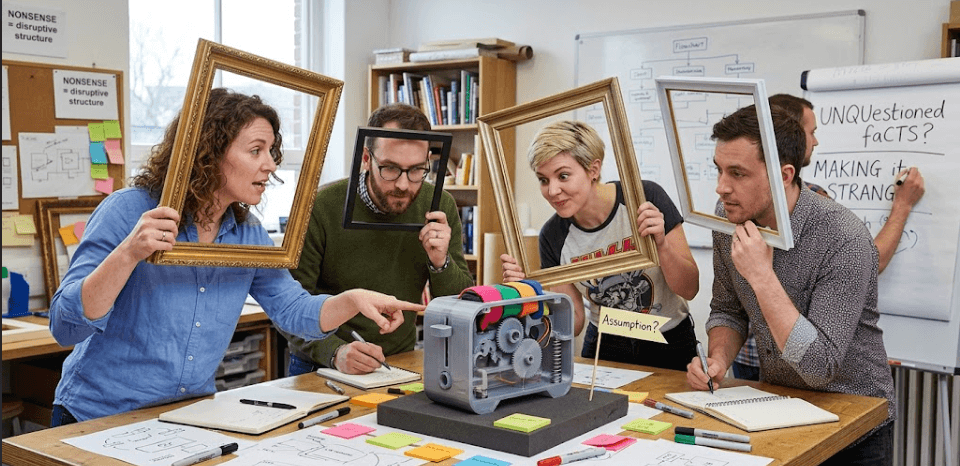
Yes, but: This does not mean filling workshops with random jokes or pursuing absurd ideas for entertainment. Purposeful nonsense disrupts an established pattern while retaining enough structure for people to recognise what has been disrupted. It makes a familiar situation strange, giving participants permission to examine assumptions that ordinary discussion leaves untouched.
Every problem contains a frame
A problem frame determines what the team notices and what it overlooks. It establishes who appears responsible, which causes seem credible, where the system boundary sits, and which interventions become imaginable. Scope often controls this framing. And this is why in advanced UX organizations, user research is front-loaded in the product lifecycle to inform business teams and product roadmaps before decisions are baked without user involvement.
Consider the statement, “Employees are resistant to the new system.” This frame places the problem inside employees. It suggests that the system is broadly correct, adoption is the employee’s responsibility, and resistance is an obstacle to overcome. Providing help (guidance), training, communications, incentives, or enforcement become the obvious responses.
A different frame might be, “The new workflow conflicts with how employees complete time-sensitive work.” Another might be, “Employees accept personal risk but receive little direct value from sharing information.” A historical frame (see Backward Journey Mapping) could reveal that earlier monitoring initiatives damaged trust. Each definition directs the organisation toward different research questions and interventions.
The problem has not merely been reworded. Its meaning, ownership, and possibilities get changed.
Richard Buchanan described design problems as fundamentally indeterminate. Designers use provisional placements to organize uncertain situations and make exploration possible. Those placements are necessary, but they can become restrictive when teams stop recognizing them as choices. Buchanan’s Wicked Problems in Design Thinking provides an important foundation for understanding this relationship between framing and design action.
Nonsense breaks the expected pattern
One of the best presentations I saw at the bi-annual Design and Emotion conference was by Amy Bickerton. The topic was nonsense in design. She shared research showing how improv actors (comedians) were able to outperform designers using improv (which gets you ready for nonsense framing). But that also designers were able to improve their solutioning by learning improv skills. It’s the reason I’ve been teaching improvisation skills this past five years.
Nonsense, research shows, is a frame-breaking catalyst. Bickerton’s model involves three movements: organization, disorganization, and reorganization.
- Organization is the current pattern. It includes the accepted problem definition, established categories, familiar language, and assumptions treated as common sense.
- Disorganization introduces a deliberate contradiction, reversal, exaggeration, or unexpected combination. The established interpretation temporarily stops working.
- Reorganization happens when participants search for a new pattern. They connect the disrupted elements differently and construct another explanation.
This final step distinguishes productive nonsense from random confusion. The purpose is not to leave people without meaning. It is to create the conditions in which they participate in making new meaning.
Bickerton argues that nonsense can work as a rhetorical device because it challenges expectations without directly imposing a replacement belief. People must actively reorganise the information themselves. This intellectual and emotional participation can support a more transformative breakthrough experience. Read her paper: Nonsense and Transformative Experience.
How disruption supports new thinking
Human beings continuously search for patterns. When a familiar pattern breaks, the mind attempts to restore coherence.
Research by Travis Proulx and Steven Heine examined what happens when people encounter a “meaning threat.” Participants exposed to an absurd Kafka story later performed better in an unrelated artificial grammar-learning task. The researchers suggested that a disruption in meaning may intensify the search for other patterns. The study was published in Psychological Science.
This finding does not mean that any confusing experience automatically improves creativity. Poorly structured nonsense can frustrate, distract, or exclude people. The useful principle is more specific: an unexpected but interpretable disruption can loosen an established pattern and stimulate the search for another one.
For designers, this creates an opportunity. We can thoughtfully disrupt the assumptions holding a problem definition in place, then support participants as they construct and test alternatives.
The connection between humor and reframing
Humour also interrupts expected patterns. A joke establishes a recognisable premise, encourages an interpretation, then introduces an incongruous connection. The result works when the connection is surprising but relatable.
If the connection is too obvious, the response is indifference. If it is completely disconnected, the audience becomes confused. Productive incongruity occupies the space between those outcomes.
Problem reframing operates similarly. A new frame must challenge the current interpretation while retaining a credible relationship with the situation. “The service is secretly operated by pigeons” may be amusing, but it provides little value unless the proposition exposes something relevant about the speed of communication, in the case of these products:
FlyPigeon: A novelty service at FlyPigeon that lets you compose messages online that are printed and dispatched physically via the postal service (mimicking carrier pigeon delivery)
Carrier Pidge: A viral new service intentionally slows down electronic messaging to the flight speed of a real homing bird. Created by independent developer Noah Larrobino, the app has sparked a trend in “slow tech” and digital detoxing.
Four ways to construct purposeful nonsense
Bickerton identifies four broad ways to disorganize familiar information. These can be adapted into practical frame-breaking tools for design teams.
The first is to reverse or invert. What if your AI assistant gave you a performance review? “You scheduled a meeting to prepare for another meeting. Talk me through that decision.”
Suddenly, the human has to explain the workflow to the machine. Why does that approval need six people? Why are three teams writing the same report? The reversal opens a different design question: “How could AI help us recognise work that no longer needs doing?” This is exactly the approach to AI that Curioser AI is taking.
The second is to reduce or expand. What if the service had one user, or one billion? What if the journey lasted thirty seconds, or three generations? Changes in scale expose assumptions about capacity, frequency, time, and consequence.
The third is to layer or combine. What if a policy behaved like a colleague? What if onboarding worked like border control? What if the complaints process operated as a subscription service? Combining categories can reveal the behavioral qualities hidden inside neutral organisational language.
The fourth is to change or rearrange. What if recovery began before failure? What if delivery happened before approval? What if users wrote the requirements and suppliers evaluated the business case? Rearranging sequence and authority exposes dependencies and power relationships.
The absurd proposition is only the beginning. Its value comes from asking three questions: which expectation did it violate, which assumption did it expose, and which plausible alternative did it reveal?
Nonsense can expose power
Problem frames are never entirely neutral. They distribute responsibility, credibility, effort, risk, and authority.
A frame such as “vulnerable users struggle to complete the form” makes difficulty appear to be a property of the users.
Or: “The service requires users under stress to interpret complex evidence rules” places the difficulty within the interaction.
Or: “The council freezes your housing payment while checking a discrepancy. Your landlord still expects Friday’s rent.” This exposes the power imbalance: the council controls the timetable. You carry the debt while it decides.
Absurdity can expose unfair rules by swapping who follows them. Imagine the council needs your permission to freeze your housing payment. It must upload evidence and call you between 9:00 and 9:30. They send a recorded message says: “Your request is important to us. Please allow six weeks for a decision.”
The joke puts the council through its own process. It makes the waiting, paperwork and lack of control tangible. That gives the design team something specific to challenge: why must residents explain every missing document, while the service never explains its delays?
Yes, But: Humor requires care here. It should challenge systems, conventions, and authority. It should never depend upon mocking the people already experiencing the greatest burden. Participants should not be required to perform comedy, disclose personal experiences, or respond quickly to participate successfully.
Stay grounded in evidence
Nonsense deliberately creates distance from the current frame. It does not remove the need for evidence (user research).
Design should start with research. Nonsense can help expand meaning. Then, after generating alternative interpretations, designers must return to research. Each proposed frame should be traced to observations, interviews, service data, historical decisions, organizational behaviour, or lived experience. See Why AI can’t have lived experience and why that’s a problem
Teams should ask whether the new frame explains the situation, reveals something previously hidden, creates meaningfully different intervention choices, and remains open to challenge.
This creates a disciplined flow from sense to nonsense and back to new sense.
The evidence may support the original problem definition or sharpen it. Other explanations may prove equally useful. If you’re lucky it can reveal that the problem was framed to justify a solution leadership already wanted—or avoid a topic stakeholders were reluctant to address.
All of these outcomes are useful!
Making problems strange again
Design methods often encourage teams to move quickly from research into problem statements and ideas. The resulting activity can appear creative while remaining contained inside familiar assumptions.
Nonsense slows that transition. It interrupts the apparent inevitability of the brief. Humor reveals contradictions. Improv allows participants to build interpretations collectively. Frame-breaking techniques move the problem across different scales, roles, sequences, histories, and power relationships.
Nonsense is serious work but conducted through playful means. Anyone who has used Lego Serious Play can attest.
The objective is not to make design funnier. It is to make inherited definitions less powerful. When a team can see its frame as a frame, it gains the freedom to question it, replace it, or hold several frames at once.
Productive nonsense gives us enough familiarity to recognise the situation and enough strangeness to reconsider it.
Explore nonsense in design: Join one of my upcoming sessions on nonsense in design:
- How Nonsense Breaks Assumptions into Design Solutions (FREE)
- Nonsense for Design Innovation-part 1 (3 hrs cost: USD $99 included in your membership- starts at USD $49 per month, cancel anytime).