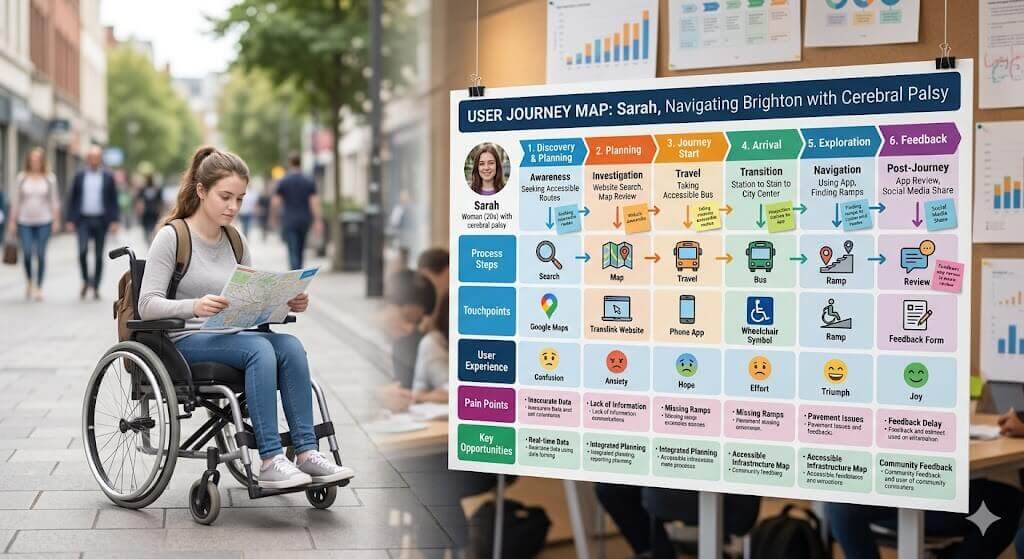
Summary: Accessibility isn’t just a compliance exercise anymore. Instead, it can show you how well your service holds up under stress, at the edges, and for the people who need flexibility the most. Taking a journey-level view of accessibility shifts you toward solving for user goals, not just for accessible widgets that might work, then fail, as users move through their access journey.
Upcoming learning experiences starting:
July 8th: Service Design Intensive- Design for End-to-End experiences
July 14th: Journey Mapping Deep Dive Lab (focus Neurodiversity)
Oct 7th: Inclusive User Research (focus Neurodiversity)
Accessibility Is an End-to-End Design Problem (Not a Feature)
Sadly, most organizations still treat accessibility like a checklist item. Audit a screen. Fix some contrast. Add ALT text. Improve keyboard navigation. The focus in most teams is still on accessibility as a technical task. Which 50% of it is…
Yes, but: there’s a difference between technical accessibility and inclusive design. Beyond ‘fixing an image or a form’ is an end-to-end experience. In short, the access journey is wider than your ALT text.
Thankfully, more and more organizations are making the “shift left” to bringing accessibility in earlier in the process— instead of the reactive, quality-assurance mindset that plagues making tech accessible. This will continue with WCAG 3x, which addresses this issue for the first time.
Still, one area accessibility efforts don’t touch is what’s happening around the access journey. Once we take a journey view, accessibility isn’t a screen-level problem — it’s a service-level one. And if your organization is only measuring accessibility at the component level, you’re missing where it actually breaks.
The Real Question Isn’t “Is This Page Accessible?”
The question that matters is: can someone actually complete their goal, start to finish?
Answering that requires an end-to-end view of the journey, not a snapshot of a single interface.
Accessibility Fails at the Weakest Link
Service designers talk about journeys because users don’t experience organizational boundaries — they experience outcomes. Accessibility works exactly the same way: one broken step can undo an otherwise excellent experience.
Picture a train station where every platform has ramps, every ticket machine supports screen readers, and every sign uses plain language — but the only entrance has stairs. That station isn’t accessible. One weak link erases everything else.
The Google Drive Example
Google has invested heavily in document accessibility. A well-built document can be screen-reader compatible, fully keyboard accessible, properly structured, and easy to navigate.
But now imagine (this actually happened) a blind user is given access to a fully accessible document. However, Drive puts docs in a shared folder. These shared folders are not accessible. The result? The user can’t find the file.
The document is technically accessible. The service is not. Accessibility stopped at the artifact and never reached the journey. The root cause is treating accessibility as a feature-level technical fix. Instead now see accessibility as a wider journey that requires an end-to-end solution perspective.
It happens like this: One team owns onboarding. Another owns authentication. Another owns content. Another owns support. Each may pass its own accessibility audit — yet the user still gets stuck, because no one owns the space between the parts.
None of this is on a VPAT® (Voluntary Product Accessibility Template). VPAT’s are part of accessibility theater. Why? Because they are voluntary (self-declared) and used as political tools to how compliance (usually to negotiate software sales relationships).
Another issue is taking an accomodations mindset to accessibility. At a local government department I worked for, they had ‘get an accessible version of this document’ (compliance) then it went to the general contact form…and ‘we’ll get back to you in 20 days’.
See: 5 proven strategies to change how you think about, and do, Digital Accessibility
Real-World Examples of Journeys That Break
- Accessible website, inaccessible PDF. The site meets WCAG standards, but the application form is a scanned PDF. Journey fails.
- Accessible app, inaccessible support. A banking app works flawlessly with a screen reader, until the user is locked out and the call center demands visual ID verification. Journey fails.
- Accessible product, inaccessible procurement. An employee needs assistive technology, and it takes six months to get approved. Journey fails.
- Accessible form, inaccessible confirmation. The form itself is easy to complete, but the confirmation email is full of broken, inaccessible links. Journey fails.
- Accessible building, inaccessible social environment. The office has ramps and lifts, but noise levels are so high, Autistic individuals are not able to tolerate them. Journey fails.
None of these failures show up in a component-level audit. All of them show up in the lived experience of a user trying to get something done.
Accessibility Is Service Design
Accessibility and service design share the same DNA. Both focus on outcomes over outputs. Both focus on removing barriers. Both require looking at the entire journey rather than isolated touchpoints. Both tend to expose organizational silos that would otherwise stay hidden.
Accessibility isn’t just compliance but diagnostic. It shows you exactly how well your service holds up under stress, at the edges, and for the people who need flexibility the most.
The Shift Organizations Need to Make
Stop asking, “Is this accessible?”
Start asking, “Where could this journey break for someone with different abilities, technologies, contexts, or needs?”
That single reframe moves accessibility out of the checklist and into systems thinking, from a compliance task into a service design discipline. It also shifts from a technical team’s job into an organizational responsibility.
Users with disabilities don’t experience features, they experience journeys. Only by seeing access as a journey-level issue can we do justice to accessible user experience.
Frank Spillers is a service designer and educator at UX Inner Circle, teaching organizations how to design accessible, end-to-end service experiences. More bio details below.
Upcoming learning experiences starting:
July 8th: Service Design Intensive- Design for End-to-End experiences
July 14th: Journey Mapping Deep Dive Lab (focus Neurodiversity)
Oct 7th: Inclusive User Research (focus Neurodiversity)